Posted on Leave a comment

Jewel-Delvers of Nagor Kadir: Ghostgates

One of the objectives of the Scimiar System is for multi-genre play— Whilst Jewel-Delvers of Nagor Kadir focuses on technology based in a medieval fantasy world, it introduces Ghostgates allowing travel between worlds and time.

A futuristic scene featuring a cowboy-like character alongside a robot and an anthropomorphic raccoon, standing in front of a vibrant energy portal in a desolate landscape with a ruined tower in the background.

We wanted the Scimitar System to support play across multiple genres where characters from a lower technology medieval fantasy world can pass into a high technology alien world, and vice versa. We also wanted to have the option to explain future technology appearing in worlds that haven’t yet reached that level of technical achievement.

To support this, we have introduced a method for travelling across space and time that exists within all worlds within the Scimitar System family of settings—ghostgates. Ghostgates are dangerous tears in the fabric of space and time, and open up a huge possibility of adventure.

No one remembers when the first shimmering ghostgate appeared. It was aeons past. Some say the gods created them, some say they are a fault in the coding of the multiverse’s structure. However they came to be, they appear suddenly, tearing through the fabric of the world before fading with no trace. Some stay active for hours, others for weeks. As small as a man or as big as a mountain, they vary in shape and size. Appearing in the sky, on the ground, in deep caves, and beneath the sea, the only certainty is that somewhere in a distant world, a glitch has opened to somewhere else, creating a temporary pathway through space and time.

The first traveller through a ghostgate was never seen again—at least not by the world they left behind. The anomalous ghostgates transport those that step through them into other worlds, other times, other dimensions. One-way doors to fantastic, inhospitable, abundant—and often—deadly places. There is no returning. Once passed through, these curious portals leave a fading ghostlike remnant in the arrival-world, with no way to get back home. Travellers become lost and found in an instant. The only hope is to find another ghostgate, hoping it will lead back to familiarity, but they never do. Some worlds protect newly spawned arrival gates with military force, fearing what may come through, others are not advanced enough to understand these curiosities and suffer the fate of whatever the ghostgate’s regurgitation brings. Known by many names; ghostgates, worldgates, devilmaws, black portals, world tears, or doors of the lost, they rarely bring hope. However, one thing is always certain, whatever and wherever the world may be, somewhere within it there are those who want to exploit, discover, raid, befriend, trade, and conquer; slobbering horrors hunting for prey or food; or lost travellers simply looking for ghostgates leading home.

Ghostgates are a fundamental feature of the Scimitar System’s multigenre game. How they look and function is going to be useful when explaining their operation and how characters interact with them. The following is a list of key ghostgate features:

  • Creation: Ghostgates form on origin and destination worlds simultaneously.
  • Appearance: The gates mostly tend to be vertical or horizontal tears but can vary is shape.
  • Size: The smallest gates allow a human-sized body to squeeze through. The largest known gates are well over 1,000 feet wide.
  • Viewing from the Origin World: From the origin world side, the destination world is visible through the gate but appears as a ghostlike shimmering/glitchy image. It can be entered from this side.
  • Viewing from the Destination World: From the destination world side, the origin world is visible through the gate but appears as a ghostlike shimmering/glitchy image. It cannot be entered from this side.
  • Activating the Ghostgate: Generally, although visible, origin world ghostgates are also intangible and functionless, unless their operation is understood. Only those sufficiently versed in occult and esoteric knowledge can understand the method to pass through a ghostgate, requiring an OCC attribute score of 10 or higher to understand how it functions. Once known, they can share this with anyone else allowing them to pass through without the necessary OCC score. Methods of operation could be learned from other sources too, such as ancient tomes, encrypted data tablets, vlogs, etc.
  • One Way: A ghostgate only allows passage one way. This is by passing from the origin world to the destination world. The gate in the destination world is intangible and Characters can pass through its image like a hologram.
  • Entering a Ghostgate: Once an object or person begins to enter a ghostgate, it enters a black nothingness of space between gates. Only when fully passed from the origin world do they begin to emerge into the destination world.
  • Opening Gates: Gates appear instantly in both origin and destination worlds with a loud tear, which can be almost deafening for the largest gates.
  • Closing Gates: Gates close gradually, fading over time (usually hours, but sometimes days and even months) until they blink out of existence. Anything or anyone partially through a portal (or within the black nothingness of space in-between) when it closes is cut into two pieces. This can be fatal for living beings.

Supporting Multigenre Play

  • Technology Levels: Worlds and equipment have technology levels which influence how they get used in differing technological worlds.
  • Wealth: Wealth is generic, and is universally used throughout. A Referee is free to use exchnage rates and world specific terms if they choose. We just want to keep it simple.

Grab the Current Rules

If you want to grab the current version of the play-test rules, then head to the feedback form here and download them from the link provided:

Thanks all, Glynn

Posted on 3 Comments

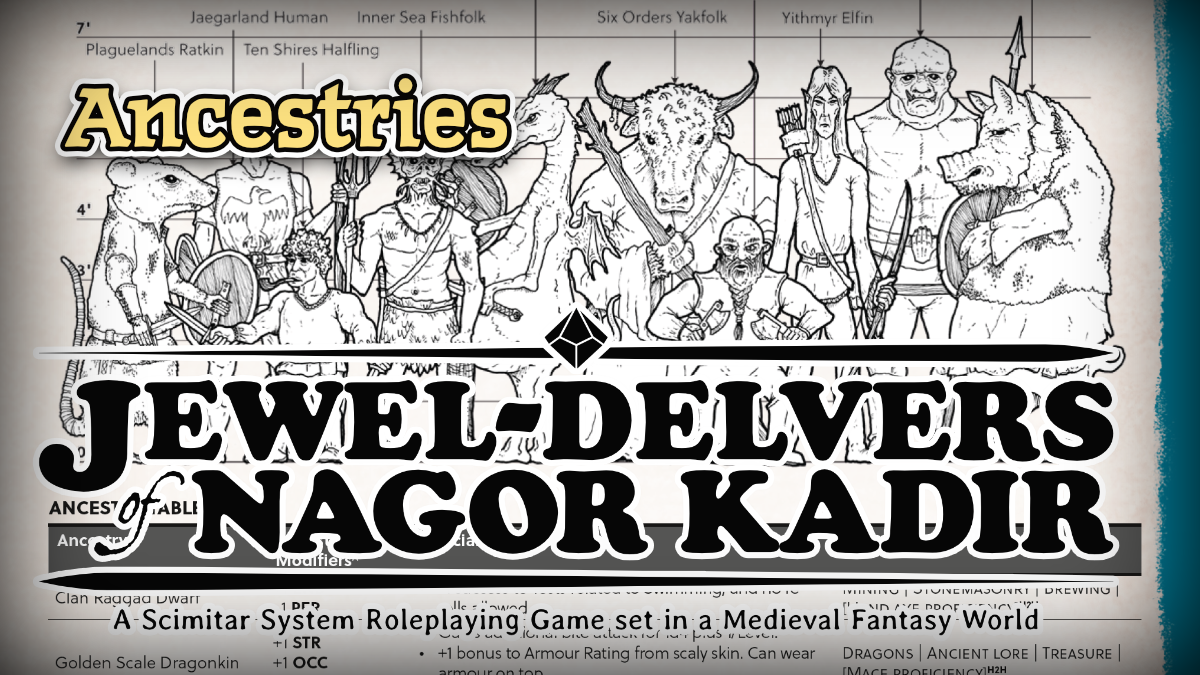
Jewel-Delvers of Nagor Kadir: Ancestries

Character creation page featuring sections on character name, levels, ancestry descriptions, and an ancestry table for a tabletop role-playing game.
Ancestries

There are 10 ancestries to play, each bringing its own strengths and weaknesses:

Clan Raggad Dwarf

These short and stocky humanoids are considered tall at 4-1/2 feet. They favour plaited beards and facial markings to distinguish their clan allegiances. They are usually dour and short tempered, but their demeanour changes when discussing mining, gold, ale, and stonework. Dwarves have slightly longer lifespans than humans, commonly extending to 120 years.

Golden Scale Dragonkin

Averaging 6 feet tall, dragonkin are bipedal dragons with pot bellies, short tails, and vestigial wings. Their bulk makes them less than agile, but they make up for it with thick leathery scales, and a long snout filled with sharp teeth. They can live to be 500 years old.

Inner Sea Fishfolk

These bipedal fishfolk are commonly 5-1/2 feet tall, and lean. Their bodies are covered in silver, blue, green and russet scales. Their hands and feet are webbed to better aid swimming, and their heads and backs are often spined or finned, and they have gills at their necks. Their eyes are large, and their mouths are wide, some filled with long thin teeth. They can live for 60 years.

Jaegarland Human

The most common ancestry on Nagor Kadir are the humans. Versatile and resourceful they can usually thrive in any location. Typically 6 feet tall.

Plaguelands Ratkin

Ratkin are the short in stature at up to 5 feet tall, but lithe and quiet. They can squeeze through the tightest of gaps and prefer to skulk in dark places. They are at home scampering through the sewer systems beneath large cities or sneaking through old crypts. Their noses twitch furiously when handling poisons.

Red Sign Half-Ogre

These commonly 7 feet tall, muscular humanoids are quick to anger and often settle disputes with shouting, threats and violence. They live hard lives within tribal groups. Their facial features are human with mottled skin tones of greys, browns and blacks. They have pronounced tusk-like lower teeth. They can live as long as humans.

Six Orders Yakfolk

These highly resourceful large-framed bipedal yaks, often reach 6 feet stooping. Their heads and bodies are covered in fur of light and dark browns. Despite their large frames, the yakfolk are frail and bruise easily with delicate skin. Their horns are a source of pride decorated with trinkets and bells of ornate crafting. Considered mystical folk by those from outside, yakfolk prefer high altitudes and elegant magics. They are expert scavengers and crafters. They can live to 150 years old.

Swinelands Pigfolk

Pigfolk are portly bipedal pigs, averaging 6 feet tall, often covered in the crumbs and juice of their last meal. They will eat anything. They do not move to action quickly, and grunt and groan whenever expending energy. They are learned in surviving outdoors and skilled in healing, especially with fungal remedies.

Ten Shires Halfling

These short and podgy humanoids commonly reach 3-1/2 feet tall. They are mostly pleasant and friendly, preferring the simple pleasures in life such as tobacco and food. They are adept at showing up without any notice, and are generally less skilled at combat than the other races in Nagor Kadir. They have similar lifespans to humans.

Yithmyr Elfin

These pale-skinned, black-eyed humanoids are tall and slender, commonly reaching 61/2 feet. Their conversations are minimal, choosing their words wisely. They are drawn to magical things and forested landscapes where they seem attuned to nature. They can live more than 300 years.

Each ancestry provides the following:

  • Attribute Modifiers. Bonuses or penalties to the six Core or six Secondary attributes.
  • Special Features. Things such as modifiers to armour ratings, seeing in the dark, being aquatic, etc.
  • Areas of Knowledge. These provide a dice reroll on related tests.

Grab the Current Rules

If you want to grab the current version of the play-test rules, then head to the feedback form here and download them from the link provided:

Thanks all, Glynn

Posted on Leave a comment

Introducing Jewel-Delvers of Nagor Kadir

Project Scimitar has evolved. The Scimitar System’s first publication has now got its final name—Jewel-Delvers of Nagor Kadir.

I’m currently working my way through the bestiary and vehicles/mounts section, but the core rules are solid and standing up well in play-testing.

Let’s introduce some of the rules in bite-size posts!

Attributes

Characters have six Core attributes and six Secondary attributes, as follows:

Core: Strength (STR), Agility (AGI), Endurance (END), Cognition (COG), Personality (PER), and Occult (OCC).

Secondary: Hand-to-hand (H2H), Ranged (RANG), Thrown (THRO), Manifesting (MANI), Handling (HNDL), and Crafting (CRFT).

The Core Mechanic

The great and versatile d10
  • To succeed at a task, you must get a number of successes equal to or greater than the task difficulty.
  • As an example, breaking a door down might require succeeding at a 2STR test. This is a STR test requiring 2 or more successes.
  • To succeed, roll a number of d10 equal to the attribute being tested. A 9 or 10 is a success.
  • Some attributes can become Favoured. When testing on these attributes, a 10 is equal to 2 successes.
  • Areas of Knowledge are things a character knows and if they can be applied to the test, they provide a reroll of a dice. More on that in another update :).

Grab the Current Rules

If you want to grab the current version of the play-test rules, then head to the feedback form here and download them from the link provided:

Thanks all, Glynn

Posted on 1 Comment

High Colonies RPG

My recent fun with Coriolis has me excited about sci-fi games.

My friends over at Columbia Games (Creators of HârnWorld) have a new Kickstarter which looks super-interesting, High Colonies! A Hard Science Fiction RPG set in the 23rd Century.

https://www.kickstarter.com/projects/columbiagames/high-colonies?ref=ed64zo

All pledge levels are digital PDF, so none of that shipping malarkey to worry about. It’s funded already, and launching through stretch goals. Here’s the video!

MBD-1

Here’s the pitch…

4a01cb6f17bd2c465e8a7162bed310c7_original

You should definitely check it out.

Many thanks, Glynn

Posted on 2 Comments

RPG Loot Call: OSE, Cha’alt & Forbidden Lands

I’ve had some pretty amazing #rpgloot turn up in the last week or two, and as I am unable to contain myself any longer, you get to hear about it. Let’s rock!

Old School Essentials

After a barn-storming Kickstarter campaign, all-round nice-guy Gavin Norman delivered a long-anticipated B/X ruleset which he has lovingly re-crafted using dweomercraft and pixie dust. What arrived is exactly what I expected and more from someone that pays attention to details. The art is beautiful and layout is beautifully-functional. None of my work in here, I’m sad to say.

I backed the Kickstarter campaign at the Thief level.

Here’s a shit-ton of photos of what turned up:

Cha’alt

Venger and I have done a LOT of work together in the past, and it was going to be the best thing we had worked on to date. I did the layout and cartography along the way.

I’m blown away by what turned up. It’s like a coffee table book you’d find in an office — well, a gonzo, post-apocalyptic, sci-fi office, but I’d put it on my coffee table as there’s not much to cause offense in here graphically (I counted just two actual nipples — on a monster). In terms of making an impact on a final project, I’m glad that I did this – it is a lovely, lovely book. Why not snag a copy if you can, Venger’s got some here: https://vengersatanis.blogspot.com/2019/10/chaalt-hardcovers-arrive.html

I backed the Kickstarter campaign at the Hardcover level because I tend to back projects that I work on out of principle (not all though, as sometimes I just don’t have/never played the systems, shipping is a bit of a mare, depends on finances, I don’t tend to do PDF-only stuff, or all of the above).

Anyway, here’s a slime-ton of photos of the book:

Forbidden Lands

And finally, Fria Ligan ran the Forbidden Lands – The Bitter Reach Campaign and Reprint campaign, and I backed this at the FORBIDDEN LANDS SECOND PRINTING level, as I was a doofus, and never backed the original Kickstarter. I think I was having ‘Why the fuck do you need another set of rules you don’t play, but need on your shelf’ fatigue.

After the first Forbidden Lands Kickstarter, I began playing in a Coriolis: The Third Horizon game, so I’m dialled into the D6 dice pool system it uses (same as Tales From The Loop, Mutant Year Zero, etc). I enjoy playing it and when I saw the second printing drop I thought; “I need an OSR fantasy-feel to my D6 dice-pool game.”. It’s a lovely box set

Once again, here’s a shit-ton of photos of what turned up. None of my work in here. The poster map is gorgeous and I love the idea of little stickers to put on it!


Posted on 2 Comments

Spells of Epic Proportions

Today, I was thinking about spells, their effects, and the caster’s level in S&W… It may have been Erik Tenkar’s Tavern Chat Podcast that planted the seed.

I’m sure there are other systems that have dealt with this already, but spells are cast to generally create some beneficial effect. The power of these effects dictate the Spell Level, which then dictates the required level of the caster that can cast it. In a nutshell, you cannot cast anything that is too high a Spell Level.

Let’s take a Level 1 Magic-User as an example. He can cast a Magic Missile, but not a Fireball.

So, why can’t they?

It doesn’t make a lot of sense if a Level 1 Magic-User with 17 INT has the same INT score as a Level 6 caster, surely they could learn it, but maybe their bodies and minds are not prepared for the endurance needed — that comes with Levels.

This brings to mind the AD&D1E version of the Staff of the Magi and Staff of Power with their Retributive Strike (nuclear) option, where the staff could be broken to deal a catastrophic, deathly strike. This higher-powered effect is very beneficial, but comes at a high cost. It’s a great narrative tool for a game too. Stories can be told of the colossal battles and their great cost. It also gives casters a new-found respect.

How can we make that possible? Well, here are some thoughts.

  • Gimme All The Spells: A Magic-User can cast spells of any level providing they are known and memorized.
  • They Sacrificed Themselves: Casting a spell where the Spell Level is 3 or more levels higher than the current maximum Spell Level the caster can cast, will die 1d4 rounds after casting (successful or not — see below). No Saving Throw. Only a Wish spell can reverse it. Example: A caster casting a Level 4 spell, when they can only normally cast a Level 1 spell, will die after casting.
  • Spell Casting Failure: For each Spell Level above the usual maximum you can normally cast, has a 10% chance of failure. A caster that can normally cast a Level 3 Spell can cast a Level 9 spell with 60% chance of failure, and will also die after casting (even if the spell failed).
  • It Worked And I Didn’t Die: So, if you did cast it without dying, there is still a cost. Any time you have to roll to cast a spell higher in Spell Level than you can normally cast, you suffer.
    • If the spell succeeded: Take 1d4 hit points damage per Spell Level you attempted to cast. Also lose an additional random spell from your memory until you rest and re-memorize.
    • If the spell failed: You are reduced to 1d4 hit points and your memorized spells are wiped until you take a days rest and re-memorize.

Table 2

Should the risks be higher or lower? I’d love to hear your thoughts.

Glynn

Posted on Leave a comment

Desecration Rules

In writing my current MonkeyBlood Design & Publishing project Ryecroft (a cemetery-crawl), it occurred to me that there must be a toll paid for desecrating or disturbing burials. After all, it’s a morally objectionable thing for most normal folk (I’d hope).

Ryecroft Logo.jpg

Here’s my rough and ready rules…

Desecration

These rules are optional, but they do give a useful counterpoint to mindless memorial destruction.
There is something morally objectionable about disturbing the rest of the dead, and those that do become affected — some more than others. Players get drawn closer to darkness the more they torment the dead.
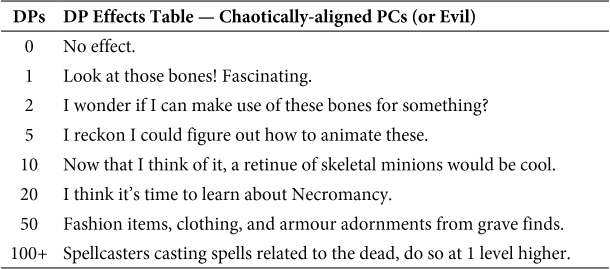
For every burial a player character disturbs — multiple burials within a single memorial count — characters gain Desecration Points or DPs. Simply observing while others open a burial doesn’t count towards DPs. Consult the DP Effects Table based on the characters alignment for the effect of DPs on player characters.

dp1.jpg

dp2.jpg

dp3.jpg

DPs can be reduced by the player characters atoning for what they have done, as follows. See the Atonement Table.

dp4.jpg