Posted on Leave a comment

The Lichseed Trilogy: A Three-Book Descent into Darkness

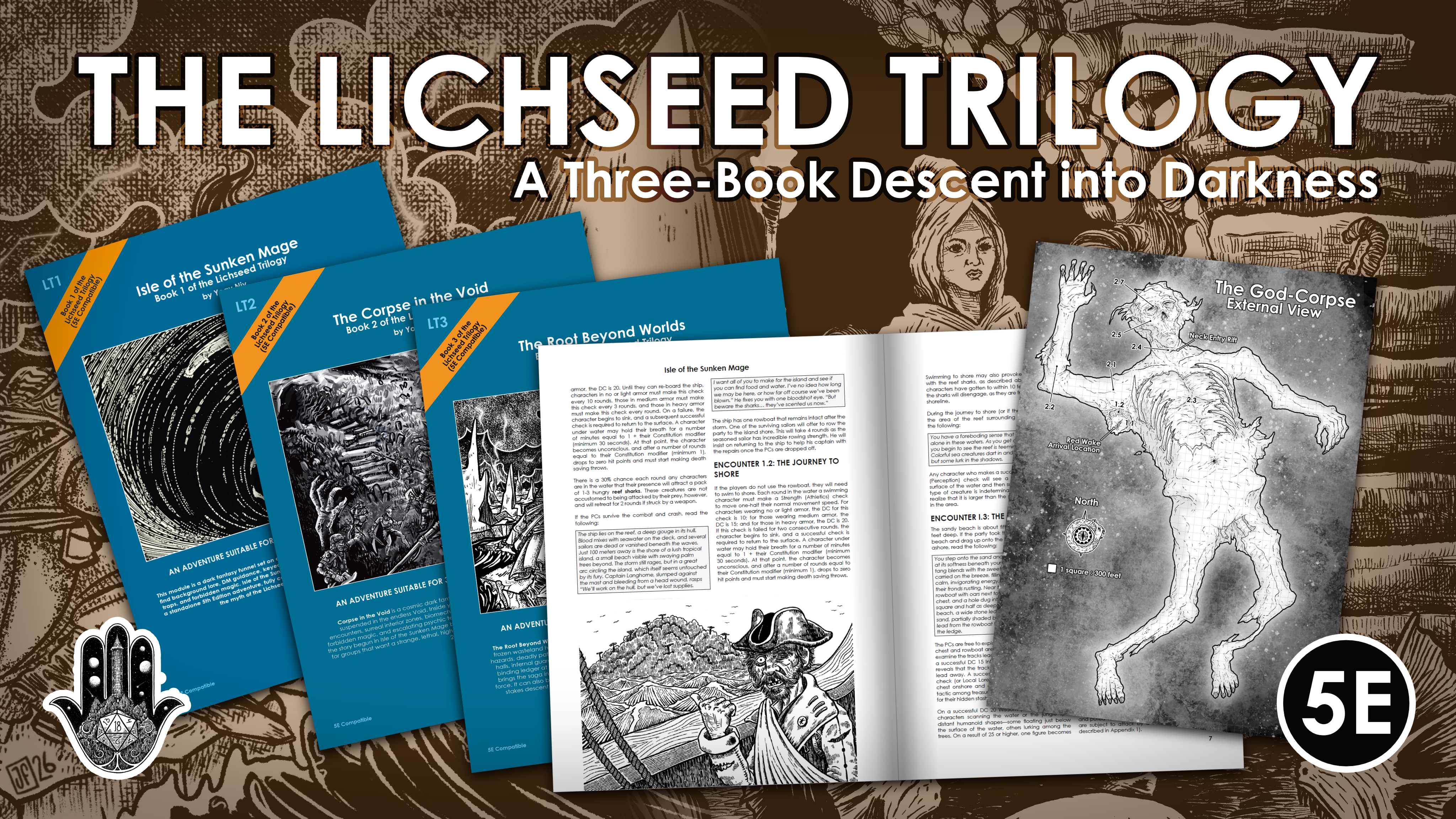
The Lichseed Trilogy is a connected series of high-stakes 5e adventures steeped in horror, mystery, and cosmic dread.

There are two ways of backing the project: Kickstarter or Backerkit! Choose your weapon!

The Lichseed Trilogy is a three-part adventure series for the fifth edition of the Dungeons & Dragons tabletop roleplaying game, compatible with both the 2014 and 2024 rulesets. Book I is already written and published. With your support, we can bring Books II and III of the Lichseed Trilogy to life! 

What’s In The Box

A failed act of forbidden magic has awakened the Lichseed, a parasitic power that spreads through soil, flesh, and stone. Its corruption twists beasts into horrors, ruins into traps, and dreams into nightmares. From the first bloom to the last withered root, the fate of entire worlds now hangs in the balance.

Book One – Isle of the Sunken Mage

A wizard’s failed lichdom unleashes the Lichseed—a parasitic bloom that warps land, beast, and mind. Explore cursed ruins. Battle horrors born of the bloom. Unearth grim truths. Already published in 5e and Shadowdark!

Book Two – The Corpse in the Void

Corpse in the Void
is a cosmic dark fantasy adventure set upon the drifting body of a dead god, suspended in the endless Void. Inside you’ll find background lore, DM guidance, deadly surface encounters, surreal interior zones, biomechanical horrors, corrupted dwarven survivors, alien technology, forbidden magic, and escalating psychic terror. As the second chapter in the Lichseed Trilogy, it continues the story begun in Isle of the Sunken Mage but can also be adapted as a standalone 5th Edition adventure for groups that want a strange, lethal, high-concept descent into the unknown, compatible with both the 2014 and 2024 rulesets.

Book Three – The Root Beyond Worlds

The Root Beyond Worlds is a brutal infernal break-in adventure set across a drifting floe of cursed ice, a frozen wasteland haunted by the damned, and the black pyramid of Set itself. Inside you’ll find planar hazards, deadly patrols, soul-breaking environmental effects, treacherous infiltration challenges, trapped halls, infernal guardians, Egyptian-inspired dungeon chambers, and a final struggle to shatter the soul-binding ledger at the heart of the pyramid. As the third chapter in the Lichseed Trilogy, this adventure brings the saga into Hell itself, where cunning, stealth, negotiation, and nerve matter more than brute force. It can also be adapted as a standalone 5th Edition adventure for groups that want a lethal, high-stakes descent into an alien infernal stronghold, compatible with both the 2014 and 2024 rulesets.

Check out the Lichseed Trilogy and back it today!

Posted on Leave a comment

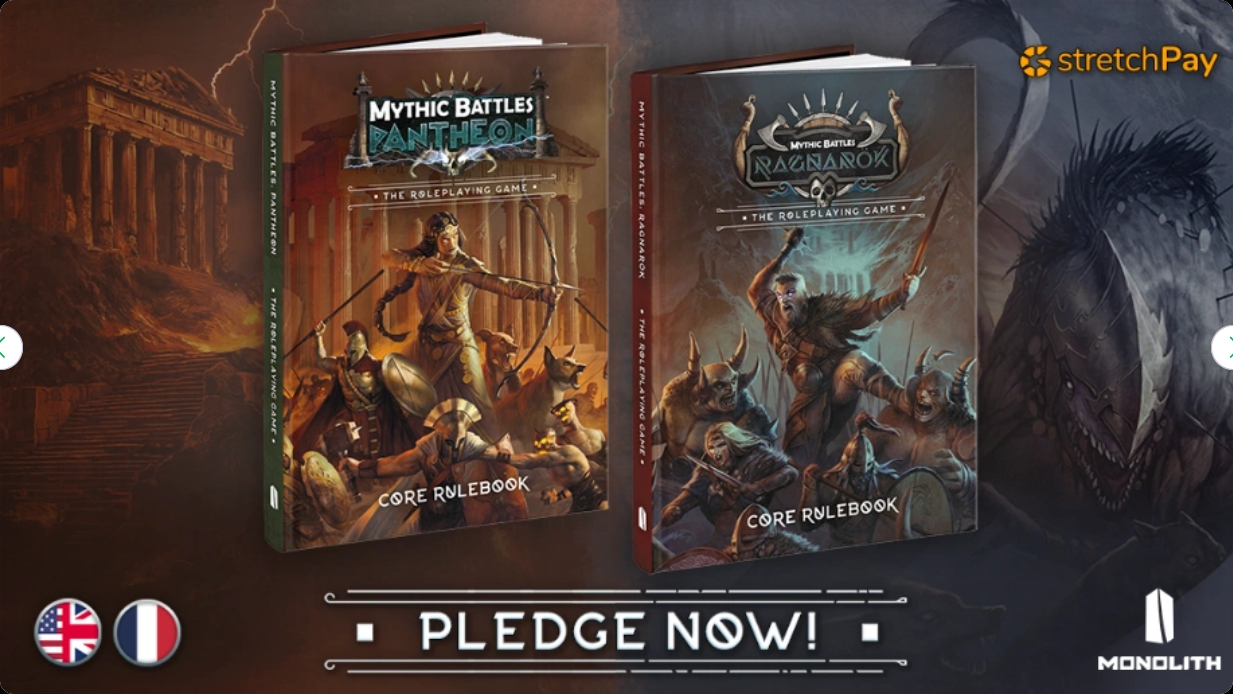
Mythic Battles: The Roleplaying Game

https://gamefound.com/en/projects/monolith-board-games-sarl/mythic-battles—the-roleplaying-game

Welcome to the Mythic Battles Roleplaying Game.

Based on the acclaimed board games, this tabletop RPG invites you to become a divine Champion fighting for survival in the ruins of broken worlds.

Two Massive Settings and Metaplots. One Lethal Engine.

The Mythicverse plunges you into a brutal, alternative timeline of the great myths, where the gods are desperate and humanity is on the brink of extinction:

Pantheon: Olympus has fallen. The devastating war between the Gods and the Titans has left Greece bleeding. As survivors cower in the ruins, a new supernatural threat emerges: the Putrescence. This mysterious, deadly rot is slowly suffocating the cosmos. Dive into the political intrigues of weakened deities and stop the Titans from corrupting what is left of the world.

Ragnarök: The prophecies lied. The Fimbulwinter is endless and the sun is dying. The Bifrost has been destroyed, isolating Midgard and freezing the war in a bitter stalemate. As the dark Sattmala Coven awakens and the followers of Surt and Fenrir seek to break the Titans’ chains, you stand as the last beacon of hope in a frozen land plunged into shadow.

Powered by a highly tactical, player-facing system where the GM never rolls, you must manage your vital resources and survive the brutal death spiral to forge your legend.

Fully written, beautifully illustrated, and shipping in less than a year.

Retweet like tweets are still a thing! Check out Mythic Battles: The RPG!

Posted on Leave a comment

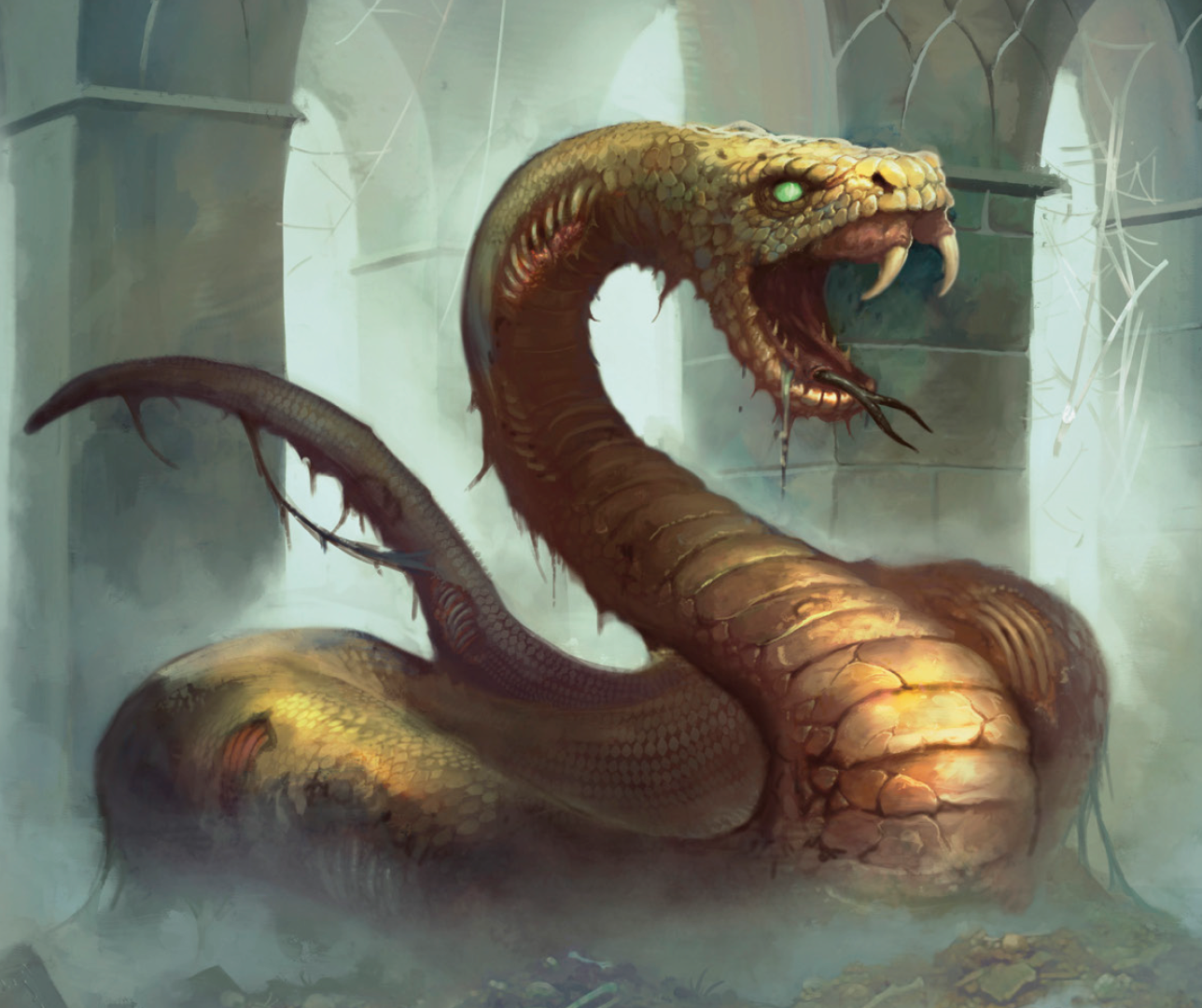
Lost Shrine of the Necrophidian

The high priest of a major temple explains that he is seeking to find the location of an ancient burial site of historical significance. It has recently been discovered out in the Tarnnis desert.

An artifact—now in his possession—was taken from the site, and the thief was captured and died from ‘natural causes’. The Player Characters are tasked to help find the site, but are double-crossed by the malign high priest.

Can the player characters survive finding the site and what is the high priest trying to keep secret?

Retweet like tweets are still a thing!
Check out this cool adventure for Beyond the Black Sea!

Posted on Leave a comment

Mice of Legend – Omnibus Volume 1

I’ve had the very great pleasure to work with Alchemical Press and its owner Paul Hoeffer on the layout of a number of their products.

In particular, the Mice of Legend line which includes the Perils of Portal Lake campaign setting and adventures, in both OSRIC/1E/OSR and Shadowdark variants. Over on DriveThruRPG they also have OSE & 5E conversion guides. From the Alchemical Press website…

Tiny Heroes, Epic Adventures

Do you want something fresh, wildly imaginative, and packed with rich details? How about an adventure where your party is transformed into heroic mice, navigating a world that’s both thrilling and whimsical—where even the smallest step feels epic?

If you’re saying, “I’m in!” then Mice of Legend is your next great campaign series. Bursting with intricate lore, beautifully designed maps, and adventures that will have your players laughing, strategizing, and immersed for hours, this is the unforgettable experience you’ve been waiting for!

Step into a world where even the smallest heroes can make the biggest difference! Mice of Legend transforms your favorite D&D (and now Shadowdark!) gameplay into a thrilling, mouse-sized epic filled with towering predators, mystical relics, and heart-pounding quests.

Whether you’re a seasoned adventurer or looking for a fresh twist, our Campaign Guide has everything Dungeon Masters need to bring this tiny world to life. Your players will navigate colossal challenges in a land where a blade of grass becomes a forest, and a puddle turns into a perilous lake. It’s D&D – and Shadowdark! – from a whole new perspective!

Why Play as Mice?

Mouse-Sized Adventures: Experience D&D/Shadowdark with a unique twist—your characters are transformed into mice, and every challenge becomes larger-than-life! Sneak past predators, explore miniature civilizations, and wield magic in ways you’ve never imagined.

Easy Conversion for All D&D Systems: Our conversion tables make it simple for your table to turn their existing party into mouse-sized heroes. Written for AD&D/OSR with conversion guides for OSE (BX) and 5e, and easily adaptable to other OSR systems. Native Shadowdark editions are in play-test now and will be published in the spring of 2026.

Stunning Visuals and Maps: Over 100 hand-drawn illustrations and 50 vibrant, VTT-ready maps transport your party into a world bursting with detail. From sprawling mouse villages to dangerous lairs, every corner of this miniature world is filled with danger and wonder.

Instant Gameplay: Your adventure begins in the human realm, where a sacred relic has mysteriously vanished—only to be hidden in the world of mice. As your party transforms into their tiny counterparts, the quest to recover the relic and protect the mouse world kicks off an unforgettable journey.

More Adventures Coming Soon: Module M6 is in art and modules M7 & M8 – along with two 1-shot adventures – are written and in game testing. Each module offers new locations, new monsters, new spells, and new magic items for you to explore.

Join the Community: Stay connected and be part of the growing Mice of Legend community. Join our Discord server to connect with other DMs, share your campaigns, and get insider tips on running your adventures.

The Shadowdark versions (of the setting guide and first 3 adventuures) are coming to Kickstarter soon here, as well as the OSRIC/1E version of M6, and Whispers of the Burrow Gods (a complete mouse pantheon).

Please click the buttons to go to the Kickstarter pages and Save to get notified:

The modules are available individually as well as the setting guide, but we’ve compiled them into hardbacks too which are available soon.

This is the compiled Mice of Legend Omnibus Volume 1 hardcover, which includes the following: the Setting Guide, adventures M1, M2, M3, M4, N1, and relevant maps from the Adventure Atlas products.

Get in on the mousey action!

Posted on Leave a comment

Jewel-Delvers of Nagor Kadir: Areas of Knowledge

Areas of Knowledge are the skill system for Jewel-Delvers of Nagor Kadir and the Scimitar System.

The beauty is that anything that can be applied to a test, can be an area of knowledge. Here are some examples of areas of knowledge:

A page from a book titled 'Project Scimir - Appendices', displaying a list of areas of knowledge with associated attribute tests and proficiency levels.

Every time a test is required, and the player can use the area of knowledge, they get a reroll of 1 dice.

If you gain the exact same named area of knowledge, it provides additional ranks. If you have three areas of knowledge with the exact same named you can reroll 3 dice in a related test.

Synergistic Areas of Knowledge

When you can apply areas of knowledge to a test that do not have the exact same named they are called synergistic. You gain a reroll of 1 dice for the first area of knowledge, and a +1 die modifier for each synergistic area of knowledge.

Example: An elfin hunter has Woodland flora & fauna (Yithmyr Elfin) and Land-based fauna (Yithmyr Hunter). He is attempting to identify some spilled animal entrails on a forest path which require passing a 1COG Test rolled using his COG score of 3. He rolls 3d10 scoring a 1, 3 and 5, a failure. For his rank in Woodland flora & fauna he re-rolls the 1 getting an 8, still a failure. Now for his Landbased fauna synergistic AoK roll he applies the +1 modifier to the 8 getting a 9, granting 1 success. He passes the test and discovers it’s a brown bear’s entrails. Remember, all AoK re-rolls and SAoK modifiers are optional unless a rule states otherwise.

Applying Rerolls

Area of knowledge rerolls generally only apply to Core attribute tests (STR, AGI, END, COG, PER, and OCC).

If an area of knowledge can be applied to a Secondary attribute test (H2H, RANG, THRO, MANI, HNDL, and CRFT) they are enclosed in square brackets with the related test in superscript afterwards.

[Scimitar mastery]H2H

Example 1: The Mergalese Swordmaster profession has [Scimitar mastery]H2H, and the Street Brawler profession has [Unarmed fighting]H2H, which are enclosed in square brackets. This allows their characters to re-roll dice on each of their H2H Tests (this includes a re-roll for each attack). The Mercenary profession has Combat tactics, which isn’t in square brackets so cannot be used to influence their attack tests.

Example 2: The Elryth Sorceror profession has [Summoning]MANI, and is able to re-roll MANI Tests when manifesting summoning spells, or other summoning-related MANI tests.

Grab the Current Rules

If you want to grab the current version of the play-test rules, then head to the feedback form here and download them from the link provided:

Thanks all, Glynn

Posted on Leave a comment

Jewel-Delvers of Nagor Kadir: Ghostgates

One of the objectives of the Scimiar System is for multi-genre play— Whilst Jewel-Delvers of Nagor Kadir focuses on technology based in a medieval fantasy world, it introduces Ghostgates allowing travel between worlds and time.

A futuristic scene featuring a cowboy-like character alongside a robot and an anthropomorphic raccoon, standing in front of a vibrant energy portal in a desolate landscape with a ruined tower in the background.

We wanted the Scimitar System to support play across multiple genres where characters from a lower technology medieval fantasy world can pass into a high technology alien world, and vice versa. We also wanted to have the option to explain future technology appearing in worlds that haven’t yet reached that level of technical achievement.

To support this, we have introduced a method for travelling across space and time that exists within all worlds within the Scimitar System family of settings—ghostgates. Ghostgates are dangerous tears in the fabric of space and time, and open up a huge possibility of adventure.

No one remembers when the first shimmering ghostgate appeared. It was aeons past. Some say the gods created them, some say they are a fault in the coding of the multiverse’s structure. However they came to be, they appear suddenly, tearing through the fabric of the world before fading with no trace. Some stay active for hours, others for weeks. As small as a man or as big as a mountain, they vary in shape and size. Appearing in the sky, on the ground, in deep caves, and beneath the sea, the only certainty is that somewhere in a distant world, a glitch has opened to somewhere else, creating a temporary pathway through space and time.

The first traveller through a ghostgate was never seen again—at least not by the world they left behind. The anomalous ghostgates transport those that step through them into other worlds, other times, other dimensions. One-way doors to fantastic, inhospitable, abundant—and often—deadly places. There is no returning. Once passed through, these curious portals leave a fading ghostlike remnant in the arrival-world, with no way to get back home. Travellers become lost and found in an instant. The only hope is to find another ghostgate, hoping it will lead back to familiarity, but they never do. Some worlds protect newly spawned arrival gates with military force, fearing what may come through, others are not advanced enough to understand these curiosities and suffer the fate of whatever the ghostgate’s regurgitation brings. Known by many names; ghostgates, worldgates, devilmaws, black portals, world tears, or doors of the lost, they rarely bring hope. However, one thing is always certain, whatever and wherever the world may be, somewhere within it there are those who want to exploit, discover, raid, befriend, trade, and conquer; slobbering horrors hunting for prey or food; or lost travellers simply looking for ghostgates leading home.

Ghostgates are a fundamental feature of the Scimitar System’s multigenre game. How they look and function is going to be useful when explaining their operation and how characters interact with them. The following is a list of key ghostgate features:

  • Creation: Ghostgates form on origin and destination worlds simultaneously.
  • Appearance: The gates mostly tend to be vertical or horizontal tears but can vary is shape.
  • Size: The smallest gates allow a human-sized body to squeeze through. The largest known gates are well over 1,000 feet wide.
  • Viewing from the Origin World: From the origin world side, the destination world is visible through the gate but appears as a ghostlike shimmering/glitchy image. It can be entered from this side.
  • Viewing from the Destination World: From the destination world side, the origin world is visible through the gate but appears as a ghostlike shimmering/glitchy image. It cannot be entered from this side.
  • Activating the Ghostgate: Generally, although visible, origin world ghostgates are also intangible and functionless, unless their operation is understood. Only those sufficiently versed in occult and esoteric knowledge can understand the method to pass through a ghostgate, requiring an OCC attribute score of 10 or higher to understand how it functions. Once known, they can share this with anyone else allowing them to pass through without the necessary OCC score. Methods of operation could be learned from other sources too, such as ancient tomes, encrypted data tablets, vlogs, etc.
  • One Way: A ghostgate only allows passage one way. This is by passing from the origin world to the destination world. The gate in the destination world is intangible and Characters can pass through its image like a hologram.
  • Entering a Ghostgate: Once an object or person begins to enter a ghostgate, it enters a black nothingness of space between gates. Only when fully passed from the origin world do they begin to emerge into the destination world.
  • Opening Gates: Gates appear instantly in both origin and destination worlds with a loud tear, which can be almost deafening for the largest gates.
  • Closing Gates: Gates close gradually, fading over time (usually hours, but sometimes days and even months) until they blink out of existence. Anything or anyone partially through a portal (or within the black nothingness of space in-between) when it closes is cut into two pieces. This can be fatal for living beings.

Supporting Multigenre Play

  • Technology Levels: Worlds and equipment have technology levels which influence how they get used in differing technological worlds.
  • Wealth: Wealth is generic, and is universally used throughout. A Referee is free to use exchnage rates and world specific terms if they choose. We just want to keep it simple.

Grab the Current Rules

If you want to grab the current version of the play-test rules, then head to the feedback form here and download them from the link provided:

Thanks all, Glynn

Posted on 3 Comments

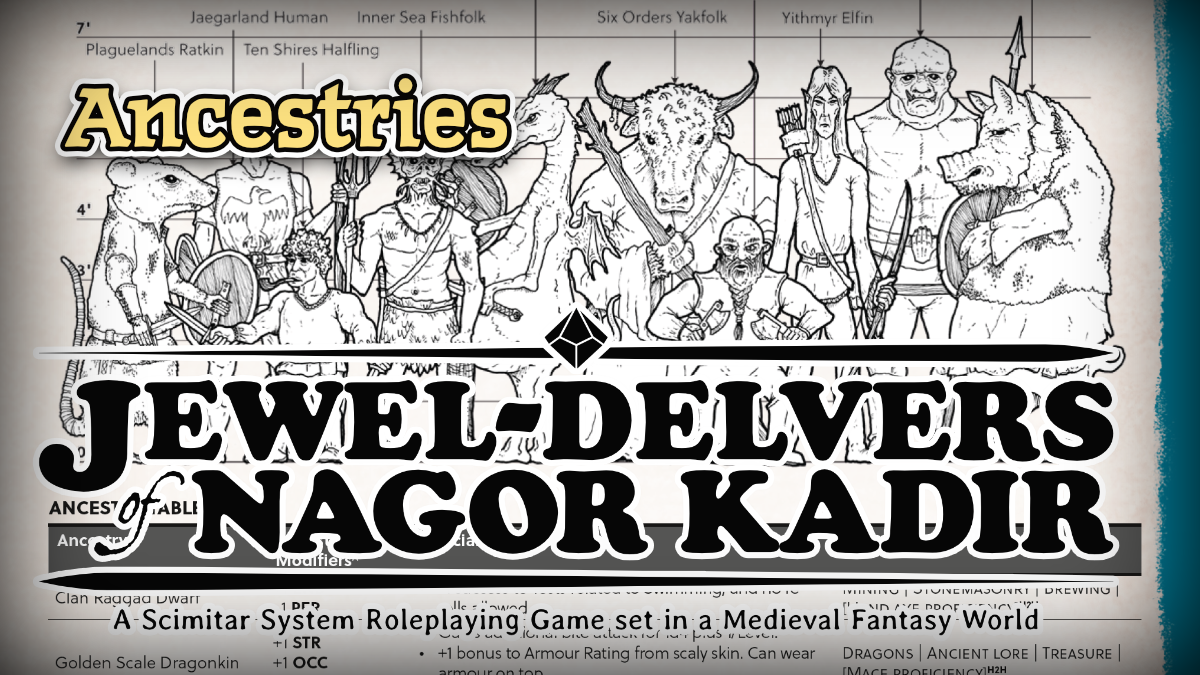
Jewel-Delvers of Nagor Kadir: Ancestries

Character creation page featuring sections on character name, levels, ancestry descriptions, and an ancestry table for a tabletop role-playing game.
Ancestries

There are 10 ancestries to play, each bringing its own strengths and weaknesses:

Clan Raggad Dwarf

These short and stocky humanoids are considered tall at 4-1/2 feet. They favour plaited beards and facial markings to distinguish their clan allegiances. They are usually dour and short tempered, but their demeanour changes when discussing mining, gold, ale, and stonework. Dwarves have slightly longer lifespans than humans, commonly extending to 120 years.

Golden Scale Dragonkin

Averaging 6 feet tall, dragonkin are bipedal dragons with pot bellies, short tails, and vestigial wings. Their bulk makes them less than agile, but they make up for it with thick leathery scales, and a long snout filled with sharp teeth. They can live to be 500 years old.

Inner Sea Fishfolk

These bipedal fishfolk are commonly 5-1/2 feet tall, and lean. Their bodies are covered in silver, blue, green and russet scales. Their hands and feet are webbed to better aid swimming, and their heads and backs are often spined or finned, and they have gills at their necks. Their eyes are large, and their mouths are wide, some filled with long thin teeth. They can live for 60 years.

Jaegarland Human

The most common ancestry on Nagor Kadir are the humans. Versatile and resourceful they can usually thrive in any location. Typically 6 feet tall.

Plaguelands Ratkin

Ratkin are the short in stature at up to 5 feet tall, but lithe and quiet. They can squeeze through the tightest of gaps and prefer to skulk in dark places. They are at home scampering through the sewer systems beneath large cities or sneaking through old crypts. Their noses twitch furiously when handling poisons.

Red Sign Half-Ogre

These commonly 7 feet tall, muscular humanoids are quick to anger and often settle disputes with shouting, threats and violence. They live hard lives within tribal groups. Their facial features are human with mottled skin tones of greys, browns and blacks. They have pronounced tusk-like lower teeth. They can live as long as humans.

Six Orders Yakfolk

These highly resourceful large-framed bipedal yaks, often reach 6 feet stooping. Their heads and bodies are covered in fur of light and dark browns. Despite their large frames, the yakfolk are frail and bruise easily with delicate skin. Their horns are a source of pride decorated with trinkets and bells of ornate crafting. Considered mystical folk by those from outside, yakfolk prefer high altitudes and elegant magics. They are expert scavengers and crafters. They can live to 150 years old.

Swinelands Pigfolk

Pigfolk are portly bipedal pigs, averaging 6 feet tall, often covered in the crumbs and juice of their last meal. They will eat anything. They do not move to action quickly, and grunt and groan whenever expending energy. They are learned in surviving outdoors and skilled in healing, especially with fungal remedies.

Ten Shires Halfling

These short and podgy humanoids commonly reach 3-1/2 feet tall. They are mostly pleasant and friendly, preferring the simple pleasures in life such as tobacco and food. They are adept at showing up without any notice, and are generally less skilled at combat than the other races in Nagor Kadir. They have similar lifespans to humans.

Yithmyr Elfin

These pale-skinned, black-eyed humanoids are tall and slender, commonly reaching 61/2 feet. Their conversations are minimal, choosing their words wisely. They are drawn to magical things and forested landscapes where they seem attuned to nature. They can live more than 300 years.

Each ancestry provides the following:

  • Attribute Modifiers. Bonuses or penalties to the six Core or six Secondary attributes.
  • Special Features. Things such as modifiers to armour ratings, seeing in the dark, being aquatic, etc.
  • Areas of Knowledge. These provide a dice reroll on related tests.

Grab the Current Rules

If you want to grab the current version of the play-test rules, then head to the feedback form here and download them from the link provided:

Thanks all, Glynn

Posted on Leave a comment

Introducing Jewel-Delvers of Nagor Kadir

Project Scimitar has evolved. The Scimitar System’s first publication has now got its final name—Jewel-Delvers of Nagor Kadir.

I’m currently working my way through the bestiary and vehicles/mounts section, but the core rules are solid and standing up well in play-testing.

Let’s introduce some of the rules in bite-size posts!

Attributes

Characters have six Core attributes and six Secondary attributes, as follows:

Core: Strength (STR), Agility (AGI), Endurance (END), Cognition (COG), Personality (PER), and Occult (OCC).

Secondary: Hand-to-hand (H2H), Ranged (RANG), Thrown (THRO), Manifesting (MANI), Handling (HNDL), and Crafting (CRFT).

The Core Mechanic

The great and versatile d10
  • To succeed at a task, you must get a number of successes equal to or greater than the task difficulty.
  • As an example, breaking a door down might require succeeding at a 2STR test. This is a STR test requiring 2 or more successes.
  • To succeed, roll a number of d10 equal to the attribute being tested. A 9 or 10 is a success.
  • Some attributes can become Favoured. When testing on these attributes, a 10 is equal to 2 successes.
  • Areas of Knowledge are things a character knows and if they can be applied to the test, they provide a reroll of a dice. More on that in another update :).

Grab the Current Rules

If you want to grab the current version of the play-test rules, then head to the feedback form here and download them from the link provided:

Thanks all, Glynn

Posted on 2 Comments

Project Scimitar

Project Scimitar has been known by many things over the years. It’s roots started in variations of Darkest of Tales, Gate Punks and Malefica, and whilst those things still exist as work-in-progress projects, they have all evolved into a game using what I am calling the multigenre Scimitar System, and this is its first game Project Scimitar (until I get closer to a commerical release and rename it).

Project Scimitar is a medieval fantasy setting in the lands of Nagor Kadir. It still needs more playtesting and fleshing out with more equipment, adversaries, spells, magical equipment, religions, and guilds. Note that some of the art is still not yet ready, and we have used some existing art as plceholder. All that said, the game core is here, and we LOVE it!

What are the bullet points?

  • Multigenre capable system design.
  • 10 Ancestries.
  • 40 Professions.
  • 6 Core Attributes (Strength, Agility, Endurance, Personality, Cognition, Occult).
  • 6 Secondary Attributes (Hand-to-hand, Ranged, Thrown, Manifesting, Crafting, Handling).
  • Core Mechanic is a d10-based success system for tests (9+ on a d10 = 1 success). Attributes determine number of dice rolled. Favoured Attributes treat 10+ as 2 successes.
  • Areas of Knowledge: Grant rerolls and modifiers to test dice.
  • Casting potentially available to all characters at any stage of character progression.
  • Crafting system for mundane and magic equipment.
  • Follow Religions, Join Guilds, or Train Familiars.
  • Handling system for vehicles/mounts.
  • Optional Game Mode to vary rules on death/Level point rewards for each individual session.

You can grab the rules in the link here: https://forms.gle/CozDGvhnJTNToNa8A.

And don’t forget to leave some feedback on your experience!

So why not roll up a character and see why we love this system?

Happy New Year and have a fabulous 2026!

Glynn and the team!

Posted on Leave a comment

Press Release: The Gaia Complex

+ + + PRESS RELEASE + + +

MonkeyBlood Design & Publishing are pleased to announce that Hansor Publishing’s amazing cyberpunk/sci-fi RPG, The Gaia Complex, as well as its supporting products, are now available on the MonkeyBlood webstore!

What Is The Gaia Complex?

The Gaia Complex is a cyberpunk RPG set on earth in 2119. At the end of the 21st century, the third world war, known as the Resource War, pushed mankind to the brink of destruction and  ruined the Earth’s atmosphere. Small pockets of humanity survived this horrific war and eventually formed the eleven metropolises . These grew and prospered due to the development of atmospheric processing and significant advancements in technology. Now cut off from each other, these heaving urban landscapes must each face their own difficulties and hardships.

The Gaia Complex focuses on the largest of these metropolises, New Europe. This single sprawling city covers much of what we currently know as mainland Europe. It is a place of street violence, corporate espionage, and vampiric uprisings. Added to this, an overzealous A.I., known as Gaia, functions as the city’s governor and the protector of its citizens.

The Gaia Complex is a dystopian world of urban violence, exploring the age of cybernetic enhancement through a vision of Earth that is somehow ‘changed’. This vision of the future injects both vampires and a strange species of people known as ferals, who are able to enter the minds of animals. In this is game of conspiracy and brutality, players take on the roles of Mercs. These former police officers, hackers, and street-savvy dealers  fight back against the system and ultimately unravel the secrets of The Gaia Complex.

Recommended products