Posted on Leave a comment

Jewel-Delvers of Nagor Kadir: Ghostgates

One of the objectives of the Scimiar System is for multi-genre play— Whilst Jewel-Delvers of Nagor Kadir focuses on technology based in a medieval fantasy world, it introduces Ghostgates allowing travel between worlds and time.

A futuristic scene featuring a cowboy-like character alongside a robot and an anthropomorphic raccoon, standing in front of a vibrant energy portal in a desolate landscape with a ruined tower in the background.

We wanted the Scimitar System to support play across multiple genres where characters from a lower technology medieval fantasy world can pass into a high technology alien world, and vice versa. We also wanted to have the option to explain future technology appearing in worlds that haven’t yet reached that level of technical achievement.

To support this, we have introduced a method for travelling across space and time that exists within all worlds within the Scimitar System family of settings—ghostgates. Ghostgates are dangerous tears in the fabric of space and time, and open up a huge possibility of adventure.

No one remembers when the first shimmering ghostgate appeared. It was aeons past. Some say the gods created them, some say they are a fault in the coding of the multiverse’s structure. However they came to be, they appear suddenly, tearing through the fabric of the world before fading with no trace. Some stay active for hours, others for weeks. As small as a man or as big as a mountain, they vary in shape and size. Appearing in the sky, on the ground, in deep caves, and beneath the sea, the only certainty is that somewhere in a distant world, a glitch has opened to somewhere else, creating a temporary pathway through space and time.

The first traveller through a ghostgate was never seen again—at least not by the world they left behind. The anomalous ghostgates transport those that step through them into other worlds, other times, other dimensions. One-way doors to fantastic, inhospitable, abundant—and often—deadly places. There is no returning. Once passed through, these curious portals leave a fading ghostlike remnant in the arrival-world, with no way to get back home. Travellers become lost and found in an instant. The only hope is to find another ghostgate, hoping it will lead back to familiarity, but they never do. Some worlds protect newly spawned arrival gates with military force, fearing what may come through, others are not advanced enough to understand these curiosities and suffer the fate of whatever the ghostgate’s regurgitation brings. Known by many names; ghostgates, worldgates, devilmaws, black portals, world tears, or doors of the lost, they rarely bring hope. However, one thing is always certain, whatever and wherever the world may be, somewhere within it there are those who want to exploit, discover, raid, befriend, trade, and conquer; slobbering horrors hunting for prey or food; or lost travellers simply looking for ghostgates leading home.

Ghostgates are a fundamental feature of the Scimitar System’s multigenre game. How they look and function is going to be useful when explaining their operation and how characters interact with them. The following is a list of key ghostgate features:

  • Creation: Ghostgates form on origin and destination worlds simultaneously.
  • Appearance: The gates mostly tend to be vertical or horizontal tears but can vary is shape.
  • Size: The smallest gates allow a human-sized body to squeeze through. The largest known gates are well over 1,000 feet wide.
  • Viewing from the Origin World: From the origin world side, the destination world is visible through the gate but appears as a ghostlike shimmering/glitchy image. It can be entered from this side.
  • Viewing from the Destination World: From the destination world side, the origin world is visible through the gate but appears as a ghostlike shimmering/glitchy image. It cannot be entered from this side.
  • Activating the Ghostgate: Generally, although visible, origin world ghostgates are also intangible and functionless, unless their operation is understood. Only those sufficiently versed in occult and esoteric knowledge can understand the method to pass through a ghostgate, requiring an OCC attribute score of 10 or higher to understand how it functions. Once known, they can share this with anyone else allowing them to pass through without the necessary OCC score. Methods of operation could be learned from other sources too, such as ancient tomes, encrypted data tablets, vlogs, etc.
  • One Way: A ghostgate only allows passage one way. This is by passing from the origin world to the destination world. The gate in the destination world is intangible and Characters can pass through its image like a hologram.
  • Entering a Ghostgate: Once an object or person begins to enter a ghostgate, it enters a black nothingness of space between gates. Only when fully passed from the origin world do they begin to emerge into the destination world.
  • Opening Gates: Gates appear instantly in both origin and destination worlds with a loud tear, which can be almost deafening for the largest gates.
  • Closing Gates: Gates close gradually, fading over time (usually hours, but sometimes days and even months) until they blink out of existence. Anything or anyone partially through a portal (or within the black nothingness of space in-between) when it closes is cut into two pieces. This can be fatal for living beings.

Supporting Multigenre Play

  • Technology Levels: Worlds and equipment have technology levels which influence how they get used in differing technological worlds.
  • Wealth: Wealth is generic, and is universally used throughout. A Referee is free to use exchnage rates and world specific terms if they choose. We just want to keep it simple.

Grab the Current Rules

If you want to grab the current version of the play-test rules, then head to the feedback form here and download them from the link provided:

Thanks all, Glynn
Posted on 3 Comments

Jewel-Delvers of Nagor Kadir: Ancestries

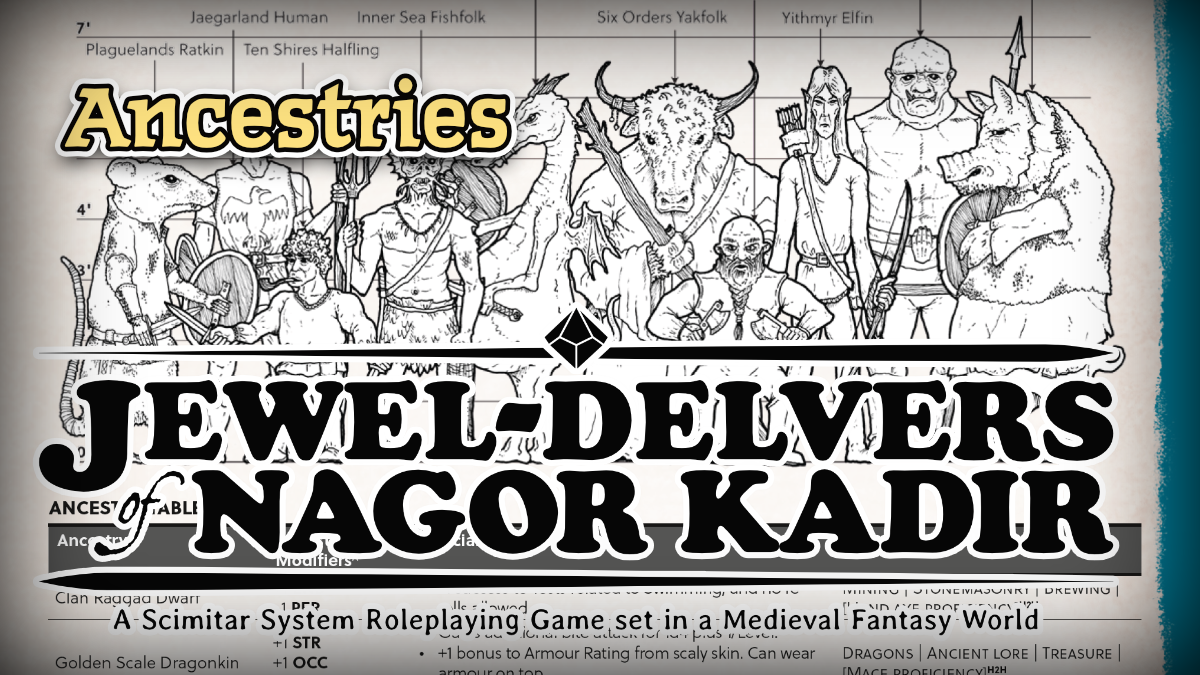
Character creation page featuring sections on character name, levels, ancestry descriptions, and an ancestry table for a tabletop role-playing game.
Ancestries

There are 10 ancestries to play, each bringing its own strengths and weaknesses:

Clan Raggad Dwarf

These short and stocky humanoids are considered tall at 4-1/2 feet. They favour plaited beards and facial markings to distinguish their clan allegiances. They are usually dour and short tempered, but their demeanour changes when discussing mining, gold, ale, and stonework. Dwarves have slightly longer lifespans than humans, commonly extending to 120 years.

Golden Scale Dragonkin

Averaging 6 feet tall, dragonkin are bipedal dragons with pot bellies, short tails, and vestigial wings. Their bulk makes them less than agile, but they make up for it with thick leathery scales, and a long snout filled with sharp teeth. They can live to be 500 years old.

Inner Sea Fishfolk

These bipedal fishfolk are commonly 5-1/2 feet tall, and lean. Their bodies are covered in silver, blue, green and russet scales. Their hands and feet are webbed to better aid swimming, and their heads and backs are often spined or finned, and they have gills at their necks. Their eyes are large, and their mouths are wide, some filled with long thin teeth. They can live for 60 years.

Jaegarland Human

The most common ancestry on Nagor Kadir are the humans. Versatile and resourceful they can usually thrive in any location. Typically 6 feet tall.

Plaguelands Ratkin

Ratkin are the short in stature at up to 5 feet tall, but lithe and quiet. They can squeeze through the tightest of gaps and prefer to skulk in dark places. They are at home scampering through the sewer systems beneath large cities or sneaking through old crypts. Their noses twitch furiously when handling poisons.

Red Sign Half-Ogre

These commonly 7 feet tall, muscular humanoids are quick to anger and often settle disputes with shouting, threats and violence. They live hard lives within tribal groups. Their facial features are human with mottled skin tones of greys, browns and blacks. They have pronounced tusk-like lower teeth. They can live as long as humans.

Six Orders Yakfolk

These highly resourceful large-framed bipedal yaks, often reach 6 feet stooping. Their heads and bodies are covered in fur of light and dark browns. Despite their large frames, the yakfolk are frail and bruise easily with delicate skin. Their horns are a source of pride decorated with trinkets and bells of ornate crafting. Considered mystical folk by those from outside, yakfolk prefer high altitudes and elegant magics. They are expert scavengers and crafters. They can live to 150 years old.

Swinelands Pigfolk

Pigfolk are portly bipedal pigs, averaging 6 feet tall, often covered in the crumbs and juice of their last meal. They will eat anything. They do not move to action quickly, and grunt and groan whenever expending energy. They are learned in surviving outdoors and skilled in healing, especially with fungal remedies.

Ten Shires Halfling

These short and podgy humanoids commonly reach 3-1/2 feet tall. They are mostly pleasant and friendly, preferring the simple pleasures in life such as tobacco and food. They are adept at showing up without any notice, and are generally less skilled at combat than the other races in Nagor Kadir. They have similar lifespans to humans.

Yithmyr Elfin

These pale-skinned, black-eyed humanoids are tall and slender, commonly reaching 61/2 feet. Their conversations are minimal, choosing their words wisely. They are drawn to magical things and forested landscapes where they seem attuned to nature. They can live more than 300 years.

Each ancestry provides the following:

  • Attribute Modifiers. Bonuses or penalties to the six Core or six Secondary attributes.
  • Special Features. Things such as modifiers to armour ratings, seeing in the dark, being aquatic, etc.
  • Areas of Knowledge. These provide a dice reroll on related tests.

Grab the Current Rules

If you want to grab the current version of the play-test rules, then head to the feedback form here and download them from the link provided:

Thanks all, Glynn

Posted on Leave a comment

Introducing Jewel-Delvers of Nagor Kadir

Project Scimitar has evolved. The Scimitar System’s first publication has now got its final name—Jewel-Delvers of Nagor Kadir.

I’m currently working my way through the bestiary and vehicles/mounts section, but the core rules are solid and standing up well in play-testing.

Let’s introduce some of the rules in bite-size posts!

Attributes

Characters have six Core attributes and six Secondary attributes, as follows:

Core: Strength (STR), Agility (AGI), Endurance (END), Cognition (COG), Personality (PER), and Occult (OCC).

Secondary: Hand-to-hand (H2H), Ranged (RANG), Thrown (THRO), Manifesting (MANI), Handling (HNDL), and Crafting (CRFT).

The Core Mechanic

The great and versatile d10
  • To succeed at a task, you must get a number of successes equal to or greater than the task difficulty.
  • As an example, breaking a door down might require succeeding at a 2STR test. This is a STR test requiring 2 or more successes.
  • To succeed, roll a number of d10 equal to the attribute being tested. A 9 or 10 is a success.
  • Some attributes can become Favoured. When testing on these attributes, a 10 is equal to 2 successes.
  • Areas of Knowledge are things a character knows and if they can be applied to the test, they provide a reroll of a dice. More on that in another update :).

Grab the Current Rules

If you want to grab the current version of the play-test rules, then head to the feedback form here and download them from the link provided:

Thanks all, Glynn
Posted on 2 Comments

Project Scimitar

Project Scimitar has been known by many things over the years. It’s roots started in variations of Darkest of Tales, Gate Punks and Malefica, and whilst those things still exist as work-in-progress projects, they have all evolved into a game using what I am calling the multigenre Scimitar System, and this is its first game Project Scimitar (until I get closer to a commerical release and rename it).

Project Scimitar is a medieval fantasy setting in the lands of Nagor Kadir. It still needs more playtesting and fleshing out with more equipment, adversaries, spells, magical equipment, religions, and guilds. Note that some of the art is still not yet ready, and we have used some existing art as plceholder. All that said, the game core is here, and we LOVE it!

What are the bullet points?

  • Multigenre capable system design.
  • 10 Ancestries.
  • 40 Professions.
  • 6 Core Attributes (Strength, Agility, Endurance, Personality, Cognition, Occult).
  • 6 Secondary Attributes (Hand-to-hand, Ranged, Thrown, Manifesting, Crafting, Handling).
  • Core Mechanic is a d10-based success system for tests (9+ on a d10 = 1 success). Attributes determine number of dice rolled. Favoured Attributes treat 10+ as 2 successes.
  • Areas of Knowledge: Grant rerolls and modifiers to test dice.
  • Casting potentially available to all characters at any stage of character progression.
  • Crafting system for mundane and magic equipment.
  • Follow Religions, Join Guilds, or Train Familiars.
  • Handling system for vehicles/mounts.
  • Optional Game Mode to vary rules on death/Level point rewards for each individual session.

You can grab the rules in the link here: https://forms.gle/CozDGvhnJTNToNa8A.

And don’t forget to leave some feedback on your experience!

So why not roll up a character and see why we love this system?

Happy New Year and have a fabulous 2026!

Glynn and the team!